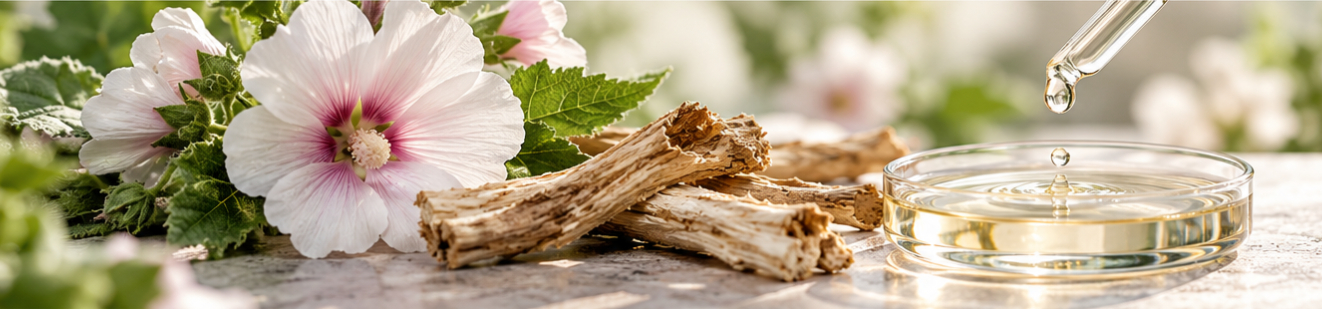
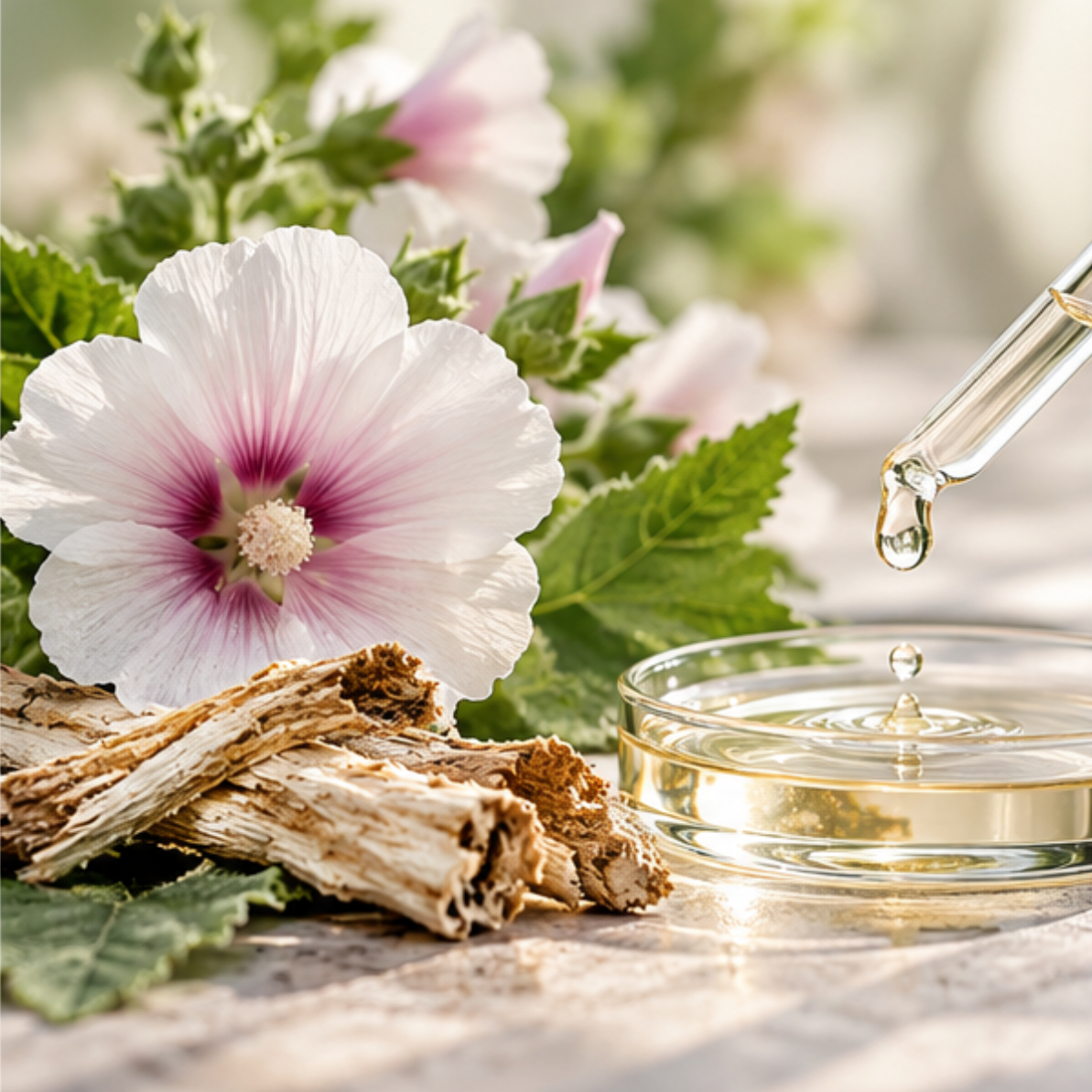
Marshmallow Extract – Benefits at a Glance
- Origin: Marshmallow (*Althaea officinalis*), mallow family (Malvaceae)
- Key constituents: Mucilages, polysaccharides, flavonoids, and other secondary plant compounds
- Cosmetic properties: Moisture-retaining, skin-conditioning, soothing, film-forming, and antioxidant potential
- Particularly suitable for: Dry, dehydrated, sensitive, stressed, and mature skin
- Applications: Creams, serums, masks, and soothing or moisturizing skincare formulations
Marshmallow Extract – A plant-based active ingredient for nourished, soothed skin
Marshmallow extract is a plant-based cosmetic active ingredient valued primarily for its skin-conditioning, soothing, and moisture-retaining properties. The extract is derived from the marshmallow plant (*Althaea officinalis*), a plant with a long tradition of use belonging to the mallow family (Malvaceae). Marshmallow is particularly characterized by its mucilages and polysaccharides.
In skincare, marshmallow extract is therefore of particular interest for dry, sensitive, or irritated skin, as well as skin stressed by external factors.
It can help improve the skin's feel, make the skin appear smoother, and support its natural moisture balance.
What is Marshmallow?
Marshmallow (Althaea officinalis) is a perennial herbaceous plant native to regions including Europe and parts of Asia. Its roots and leaves, in particular, have long been used.
For cosmetic applications, the mucilages contained in the plant are of primary importance. These are predominantly complex carbohydrate compounds—specifically polysaccharides—capable of binding water and characterized by their film-forming properties.
In addition to these components, substances such as carbohydrates, amino acids, and various flavonoid compounds have been identified in marshmallow root extracts.
Marshmallow Extract in Cosmetics: How Does It Affect the Skin?
The cosmetic significance of marshmallow extract stems primarily from its combination of moisture-retaining, skin-soothing, and conditioning properties.
1. Supports Skin Hydration
The mucilages found in marshmallow have a special affinity for water. When applied to the skin, these plant-based polysaccharides can form a light, conditioning film.
This makes marshmallow extract particularly suitable for skincare products designed to leave the skin feeling soft, smooth, and comfortably hydrated. Dry and dehydrated skin, in particular, can benefit from products formulated with this ingredient.
2. Soothes Sensitive-Prone Skin
Marshmallow is traditionally associated with soothing properties. Scientific studies on *Althaea officinalis* extracts also reveal interesting antioxidant and inflammation-modulating properties—though, to date, these findings have largely been observed in experimental settings.
Consequently, marshmallow extract is a particularly attractive ingredient for cosmetic formulations intended for sensitive, stressed, or irritation-prone skin.
3. Promotes a Supple Skin Feel
Plant mucilages can form a moisture-retaining film on the skin's surface. As a result, rough or dry skin often feels smoother and more supple.
Marshmallow extract is therefore well-suited as an ingredient in creams, serums, and other skincare formulations designed to improve skin comfort and suppleness.
4. Interesting antioxidant properties
In addition to polysaccharides, marshmallow contains various secondary plant compounds. Studies have identified antioxidant properties, among others, in extracts from *Althaea officinalis*.
Antioxidants play an important role in modern skincare because they can help neutralize free radicals. These are generated by factors such as UV radiation and other external environmental stressors, and they contribute to oxidative stress in the skin.
Marshmallow extract is therefore also of interest for skincare regimens aimed at protecting stressed skin from the effects of oxidative processes.
Which ingredients make marshmallow interesting for skincare?
Marshmallow is not a single active ingredient but a complex plant extract. Its exact composition depends on factors such as the part of the plant used and the extraction method.
Key constituents include, in particular:
- Mucilages and polysaccharides – of interest for moisture retention, film-forming properties, and a supple skin feel
- Flavonoids – secondary plant compounds with antioxidant potential
- Amino acids – natural components important for various biological processes
- Phenolic plant compounds – can contribute to the extract's antioxidant profile
- Sugars and oligosaccharides – components of the marshmallow plant's complex carbohydrate fraction
It is precisely the interplay of these groups of substances that makes plant extracts like marshmallow versatile ingredients in modern cosmetic formulations.
For which skin types is marshmallow extract suitable?
Thanks to its skin-conditioning and moisture-retaining profile, marshmallow extract is generally suitable for use on various skin types.
This active ingredient is particularly beneficial for:
- Dry skin: Moisture-binding and film-forming components can improve skin feel and make dry skin appear suppler.
- Dehydrated skin: Marshmallow extract is well-suited for skincare formulations designed to support the skin's moisture levels.
- Sensitive skin: Its traditionally valued soothing properties make marshmallow an interesting ingredient for gentle skincare routines for sensitive skin.
- Stressed skin: Environmental stressors, dry air, cold temperatures, or intense sunlight can put a strain on the skin. In such cases, soothing and hydrating care can be beneficial.
- Mature skin: As we age, skin can become drier and lose suppleness. Skincare regimens focused on hydration and antioxidant protection can therefore also be beneficial for mature skin.
Marshmallow extract and the skin barrier
An intact skin barrier is crucial for the skin's ability to retain moisture effectively and shield itself from external influences.
Marshmallow extract does not replace the skin's own barrier lipids, such as ceramides. However, its water-binding and film-forming components can complement a targeted skincare routine. When combined with humectants and lipids, in particular, it creates a care regimen that offers comprehensive support for dry and sensitive skin.
Marshmallow and hyaluronic acid – an interesting combination
Research into the relationship between marshmallow extract and hyaluronic acid is particularly intriguing.
A phytochemical study of marshmallow root extract demonstrated—in laboratory tests—an inhibition of hyaluronidase-1, an enzyme involved in the breakdown of hyaluronic acid. Additionally, reduced expression of the corresponding enzyme was observed in cultured keratinocytes.
While these results are scientifically interesting, they should not be equated with a proven anti-aging effect in a finished cosmetic product. Rather, they offer insight into why *Althaea officinalis* is of interest to skincare research.
Is marshmallow extract an anti-aging active ingredient?
Marshmallow should not be viewed as a classic anti-aging active ingredient, such as retinoids or certain peptides. Nevertheless, it can usefully complement an anti-aging skincare routine.
Well-hydrated skin generally appears smoother and plumper. At the same time, antioxidant-focused skincare approaches are valuable when the goal is to protect the skin against oxidative stress.
The benefit of marshmallow therefore lies less in a single, spectacular anti-aging mechanism than in its combination of hydration, skin comfort, soothing properties, and plant-based antioxidant potential.
Marshmallow Extract: Gentle Botanical Power for Demanding Skin
Marshmallow extract combines traditional herbal knowledge with modern cosmetics. Its components—particularly those rich in mucilage and polysaccharides—make Althaea officinalis an appealing ingredient for hydrating and soothing skincare products.
The plant extract can help make dry and sensitive skin appear smoother and better cared for, while its phytochemicals can complement a formulation's antioxidant profile.
This makes marshmallow extract particularly suitable for skincare products that prioritize hydration, soothing effects, suppleness, and skin comfort.
Häufige Fragen zur Eibisch-Extrakt in der Hautpflege
Marshmallow extract is derived from parts of the marshmallow plant (*Althaea officinalis*). The plant contains, among other things, mucilages—or polysaccharides—as well as various secondary plant compounds, and is therefore also used in cosmetic formulations.
Marshmallow extract is used primarily for its moisture-retaining, skin-conditioning, and soothing properties. Its polysaccharide-rich components can contribute to a supple and pleasant skin feel.
Yes, marshmallow extract is particularly beneficial for dehydrated and dry skin. The mucilages it contains can bind water and form a light film on the skin, which can make the skin feel softer and more nourished.
Due to its mild, soothing profile of active ingredients, marshmallow extract is of particular interest for skincare products designed for sensitive and stressed skin. However, the overall formulation of a cosmetic product is always the decisive factor regarding individual tolerability.
Marshmallow is not a classic anti-wrinkle active ingredient. However, its moisture-retaining properties can help dry skin appear smoother and plumper. Furthermore, the antioxidant properties of *Althaea officinalis* extracts are being scientifically investigated.
Plant mucilages consist largely of complex carbohydrate compounds. They can absorb water and form a moisture-retaining film on the skin, making them particularly interesting for soothing and moisturizing cosmetics.
The exact INCI designation depends on which part of the plant is used and how the extract is produced. For a root extract, for example, *Althaea Officinalis Root Extract* might be used. However, the INCI designation of the specific raw material used should always be the deciding factor for product labeling.